Object detection and tracking
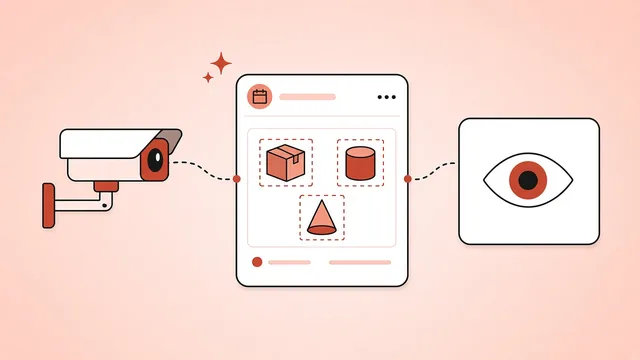
Detecting, counting and following people, vehicles, products or defects across frames, with YOLO-family and transformer-based models.
Roles · AI & Automation
Models that work on your cameras, your lighting and your hardware, measured on your own footage. Your engineer takes the work from labeled data to a model running in production.
Pretrained models look impressive on benchmark images and then miss half the objects in your warehouse at night. Getting vision to work in the field means collecting the right footage, labeling it consistently, training and evaluating on your conditions, and fitting the model onto the hardware you actually have. A computer vision engineer owns that whole loop and keeps measuring after launch.
What they do for you
Tools they work in
Strong answer: check the data for night coverage, look at failure cases by condition, add and label targeted footage, consider camera settings, and measure on a held-out night set.
Strong answer: they ask what a false alarm costs against a missed event, then pick thresholds per class with you.
Strong answer: a smaller architecture, lower input resolution, quantization, TensorRT, frame skipping and batching, each measured for accuracy loss.
Strong answer: a written guide with edge-case examples, a review step, agreement checks on overlap samples, and fixing the guide when disagreements show up.
Detecting, counting and following people, vehicles, products or defects across frames, with YOLO-family and transformer-based models.
Classification, segmentation, pose estimation, OCR and video analytics, including fine-tuning open models on your own footage.
Models compiled and tuned for NVIDIA Jetson, Intel hardware, mobile devices or on-site servers, with streaming pipelines built on DeepStream or GStreamer.
Annotation tooling in CVAT, Label Studio or Roboflow, labeling guides, quality review and active learning to label the images that matter most.
We agree the work, the tools, the hours you share and who they report to. For this role: what the model has to recognize, your cameras or image sources, the hardware it will run on, and the data you already have.
We screen a wide pool for every role and introduce only the few who fit your brief. We source, screen and test candidates against your brief, and run background and reference checks. You interview and decide.
They start on the work in the brief, and we stay in contact once they've begun.
Computer vision is a specialist field. Plan for this search to run longer than most, especially when you need edge deployment experience as well.
A computer vision engineer can be hired under any of the options shown. It's your call which one, and we can go through the trade-offs with you. Compare the arrangements on ways to hire.
Swipe to see more →
| Task | You | JiveTalent |
|---|---|---|
| What the model must detect, and the accuracy you'll accept | Own | – |
| Data pipelines, training, deployment and monitoring | Review | Built by your engineer; we follow up on progress against the goals you set |
Not always. Many projects start with a pretrained model and a few hundred labeled images from your cameras, then grow the dataset where the model struggles.
The brief sets the hours and the overlap with your team before the search starts, so every candidate is hired for them.
You do. Datasets, labels, model weights and pipeline code stay in your accounts and repositories.
Usually. They work with RTSP streams, video files and most IP cameras. Share the camera models and resolution in the brief.
Talk to your account lead. We go through it with you and agree a way forward.
They can build in blurring, on-device processing and short retention. Which rules apply to your footage is a decision for you and your legal adviser.
Their hours are tracked in the client app and reported there for you to see.
Book a call. We'll agree the brief for your computer vision engineer and talk you through the ways to hire.